Overbuilding before validating.
People spend months on logos, websites and product features before they know whether a stranger will pay. The building feels like progress; the validation gets postponed.
The framework
A practical framework for turning a raw idea into a launch-ready, market-tested business — without spending months building something nobody wants.
24 hours is not a countdown clock and it is not a promise of overnight wealth. It is a disciplined amount of focused work: the right decisions, in the right order, so you stop planning and start proving.
What it means
Most business advice treats starting a company like writing a thesis. Research, outline, revise, perfect — then, eventually, launch. The problem is that “eventually” rarely arrives. The idea stays protected, the assumptions stay untested and the founder stays busy without being productive.
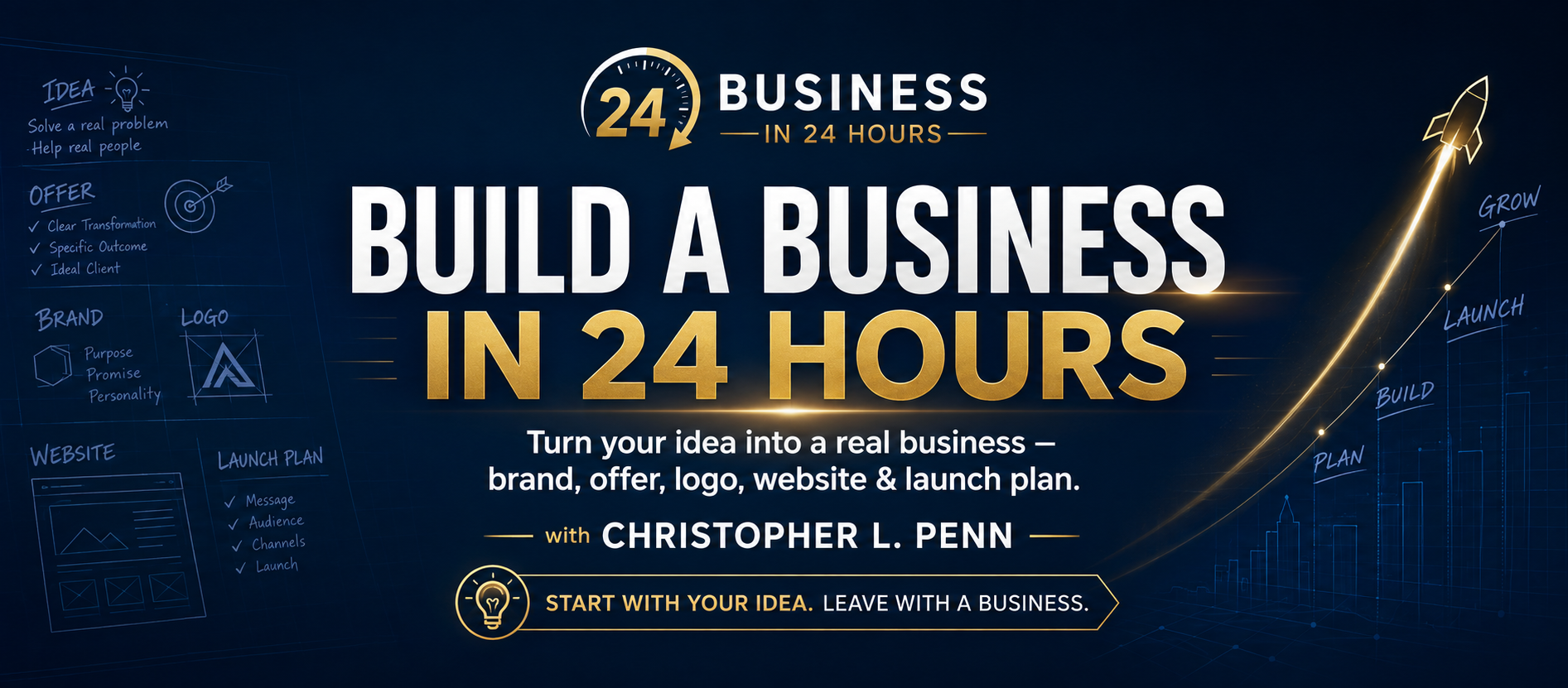
Build a Business in 24 Hours flips that sequence. It is a structured execution framework that moves an entrepreneur through the major decisions required to evaluate an opportunity, understand the customer, shape the offer, establish the business, reach the market, generate feedback and determine what should happen next.
The 24 hours are not literal clock time for every participant. They represent a complete cycle of focused work: enough to get from “I have an idea” to “I have something the market can actually respond to.”
The problem
People spend months on logos, websites and product features before they know whether a stranger will pay. The building feels like progress; the validation gets postponed.
Business plans become novels. Financial models become art. Neither answers the only question that matters: will a real buyer give you real money?
Inventory, software, leases and ads get bought to serve a theory of the market. When the theory is wrong, the losses are real.
It never feels safe. The longer the idea stays in your head, the more perfect it has to become to justify starting. Perfection becomes procrastination with a business card.
The 24-stage framework
The framework contains 24 proprietary stages completed across a focused 24-hour business-building process. Each stage is a decision point, not a mystery. Together, they move an entrepreneur from idea to a functioning, market-tested business without the usual drift.
The complete stage-by-stage methodology is reserved for participants using the Build a Business in 24 Hours system. What follows here is the high-level map: the areas the framework covers, the questions it answers and the outcomes it produces.
The framework covers areas such as
These are broad business categories, not the official stage names or sequence.
What it determines
The framework is designed to remove opinion from the early stages of starting a business. Every major decision is treated as a hypothesis to be tested against real customers, real behavior and real money.
By the end
The goal is not a perfect business. The goal is a tested business hypothesis with enough evidence to know whether the idea deserves more time, more money, a pivot or a graceful stop.
Who this is for
If you are looking for a guarantee, a shortcut to wealth or a reason to avoid talking to customers, this is not the framework for you. If you want a clear process for finding out whether your idea has legs, it probably is.
Validation before building
The most expensive mistake in entrepreneurship is building something before anybody has paid for it. The framework treats validation as a gate, not an afterthought.
I wrote a separate guide on the seven validation gates I use: the problem, the customer, existing behavior, competition, the offer, the economics and the transaction. If you are not sure whether your idea is worth building yet, start there.
“Most people don't fail at business. They never get far enough in to find out.”
Your turn
You can keep thinking about it, or you can spend 24 hours finding out what it actually is. The framework is the map. The challenge is the work. I know which one I'd choose.